

The rise of live shopping platforms and video commerce
Modern shoppers crave immediacy, personalization, and authenticity from every ecommerce touchpoint. Live shopping events deliver exactly that, offering real-time product demonstrations, influencer insights, and audience interactivity—effectively recreating the excitement of brick-and-mortar experiences right within leading social media platforms. For the full picture, see our complete live stream commerce guide.
The surge in shoppable videos and live selling empowers brands to harness impulse buying like never before. Industry data confirms that well-executed video commerce can produce conversion rates up to ten times higher than static online listings. By leveraging multichannel streaming, ambitious sellers unlock new markets, deepen brand loyalty, and nurture lifelong customers.
Comparing the main types of live shopping ecosystems
Choosing the optimal live shopping platform has a direct impact on your reach, profitability, and shopper connections. Generally, solutions fall into two camps: closed marketplace ecosystems or flexible checkout link generators. Each model supports distinct business objectives and target audiences.
What defines closed marketplace platforms?
Closed marketplace platforms like Whatnot, TikTok Shop, and Instagram Live operate as self-contained environments where all buyer-seller interactions occur under one umbrella. These systems bundle livestreaming, catalogs, payments, and logistics, creating a seamless—but tightly controlled—shopping experience. Discovery and purchase are deeply integrated, but sellers are required to list inside these walled gardens.
While sellers benefit from robust infrastructure, easy access to built-in audiences, and trusted user interfaces, competition for visibility is fierce. Marketplace algorithms favor trending streams and encourage viral sharing, yet always within their proprietary framework.
Convenience comes at a price: transaction fees diminish margins, and sellers relinquish control over both customer data and branding. Ultimately, the marketplace dictates policies regarding outreach, presentation, and relationship management.
How do direct checkout link solutions differ?
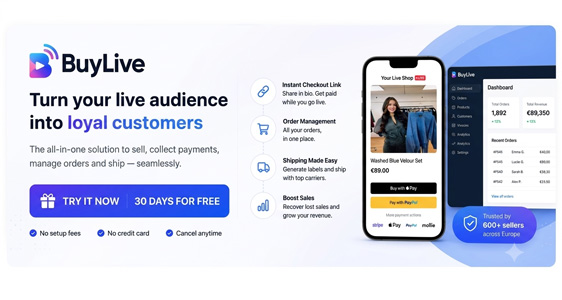
On the other hand, direct transactional checkout link solutions such as Buylive empower sellers to broadcast shoppable videos wherever their audience exists—on websites, blogs, or any social media platform. For seamless transactions, sellers can use the Buylive live shopping checkout. These tools generate instant purchase links or QR codes, letting buyers complete transactions without cumbersome redirects or external steps.
This decentralized approach means brands retain full control over their image, messaging, and most importantly, ownership of vital customer information. With no intermediary commissions, transaction costs stay low, keeping more revenue in the seller’s pocket while allowing for highly customized live shopping events.
Key factors to consider when choosing a live shopping solution
As you expand your multichannel streaming presence, it becomes crucial to weigh the trade-offs of each environment. Factors influencing your decision include revenue retention, scalability, resource requirements, and long-term growth goals. Compare these considerations against the broader social selling vs traditional e-commerce landscape.
Both marketplace-centric models and direct checkout options offer compelling benefits. Here are the essential criteria for any seller entering video commerce at scale:
- Ownership and access to customer data
- Branding flexibility and freedom
- Transaction fees and payout timelines
- Audience reach versus algorithm-driven discoverability
- Integration ease with existing ecommerce systems
- User experience and checkout flow simplicity
- Customization of live shopping events
- Support for simulcasts and multichannel distribution
Revenue margins and seller profitability
Direct checkout models clearly outperform closed marketplaces on profit margins. By eliminating third-party commissions and reducing overhead, sellers keep a larger portion of each sale. They also gain autonomy over payment processors, shipping, and customer retention strategies.
Still, closed platforms deliver fast trust-building through secure payment protocols and established buyer protections. For emerging brands, tapping into massive existing audiences may justify steeper fees as a launchpad for growth.
Data ownership and building lifelong customer relationships
For digital commerce leaders, controlling first-party data is non-negotiable. Direct checkout tools ensure sellers own every key touchpoint—from email addresses to purchase histories and behavioral patterns. This enables laser-focused remarketing, personalized engagement, and recurring sales strategies, driving long-term value.
Conversely, closed marketplaces impose stringent data restrictions. Sellers cannot fully customize messaging, promotions, or loyalty efforts, which ultimately weakens ongoing customer bonds and reduces lifetime value potential.
Multichannel streaming and maximizing audience reach
Top-performing sellers know that omnipresence fuels brand growth. Multichannel streaming enables simultaneous live shopping events across Instagram, Facebook, TikTok, YouTube, and owned sites, amplifying exposure and attracting diverse viewers. This strategy accelerates optimization and helps brands adapt quickly to shifting consumer attention. Micro-brands are leading this multichannel charge.
Embedding shoppable videos within partner blogs, editorial content, and online communities further expands your conversion opportunities. Flexibility here ensures you meet buyers anywhere—not just inside a single marketplace feed.
Platforms supporting native simulcasting
Certain live shopping platforms now support native simulcasting, empowering sellers to launch a single stream across multiple channels. This maintains consistent branding, simplifies campaign tracking, and streamlines operations for maximum efficiency.
Sellers embracing direct checkout technology can leverage these capabilities to increase creative control and reach global audiences instantly. The combination of independence and broad distribution is a major advantage for teams ready to outgrow single-channel constraints.
Integrating ecommerce and inventory management
A best-in-class live commerce engine should seamlessly sync with inventory, order management, and fulfillment partners. Closed marketplaces usually require use of their internal tools, making processes simple but less flexible for cross-channel coordination.
Standalone video commerce solutions with modular APIs support advanced scenarios: dynamic pricing, flash sales during broadcasts, exclusive drops for attendees, and multi-location routing for smooth global delivery. Enhanced notifications like waitlists and back-in-stock alerts create urgency and drive more conversions and sales per event.
Emerging trends shaping competitive advantage in live shopping
Looking ahead to 2026, the leaders in livestream shopping will stand out through innovation, agility, and community focus. Several shifts are set to redefine the market:
- AI-powered, hyper-personalized shoppable video recommendations
- Augmented reality (AR) try-ons directly in live shopping events
- Gamification features—polls, quizzes, loyalty contests—to boost engagement
- Frictionless, single-click checkout flows that minimize drop-off
- Global, cross-border broadcasting with real-time localization and multi-currency support
Brands adopting these interactive live shopping tactics not only showcase technical expertise but also build authentic rapport with audiences. The next big challenge is maintaining human connection while scaling sophisticated video commerce solutions.
What is the difference between live shopping platforms and standard ecommerce sites?
Live shopping platforms integrate video streaming and interactive features within a purchasing experience, turning passive browsing into active participation. Shoppers engage directly with hosts, ask questions in real time, and see products demonstrated authentically before buying.
Ecommerce sites present static images and product descriptions.
Live shopping enables shoppable videos, influencer opinions, and live chat engagement.
This format boosts trust and drives conversions and sales compared to traditional ecommerce alone.
How do closed marketplaces impact seller profits and customer connections?
Closed marketplaces simplify setup and provide large pools of potential customers, but often charge transaction fees that reduce overall profits. Sellers give up direct access to crucial buyer data, affecting personalized marketing and ongoing relationship management.
Closed marketplaces: lower profit margins after fees, limited customer control (data retained by platform).
Direct checkout links: higher profit margins (minimal fees), full customer control (data owned by seller).
What technologies enhance interactive live shopping in 2026?
AI-driven content curation for hyper-targeted shoppable videos.
Augmented reality (AR) overlays for product try-ons and virtual demos.
Simultaneous multichannel streaming across several social media platforms.
Instant purchase links to accelerate decision-making at peak excitement points.
Immersive and interactive tools create memorable live shopping events that outclass static listings and drive stronger performance metrics.
Can the same live shopping solution work on every social media platform?
Marketplaces may restrict broadcasts to their own networks, while direct checkout link providers let sellers reach any audience, anywhere—maximizing flexibility and control. The latter works equally well for cross-posting, co-hosted shows, or exclusive niche communities outside mainstream channels.
Native integrations improve workflow and speed across multiple outlets.
One universal solution reduces redundant content production and management.